Year: 2026
Medium: Systemic Art Project
The Infinite Rendering opens Symbiogenesis / Residual Time, the body of work developed by ArTech Team, Carlo Alfano and Dario Buratti for MAM’s immersive room. Carlo Alfano is responsible for the direction and Storyverse, while Dario Buratti oversees systemic direction and the generative grammar. The project is developed in collaboration with the AAMOD Foundation – Archivio Audiovisivo del Movimento Operaio e Democratico, whose archive of historical films and photographs becomes part of the film’s visual fabric, intertwining the memory of labour and the struggles of the twentieth century with the work’s generative imagery.
Four stages unfold as a crescendo, structured around four verbs: Narrate, Traverse, Inhabit, Merge. An immersive film, a traversable pathway, a solid volume in which the film freezes. Here, five minutes are shown, stopping at their own threshold: the point beyond which the film does not yet reveal itself, allowing the complete form to be sensed without disclosing it.
What takes place in the room is a fragment of the first episode of four events that will be presented at MAM over the coming months. This choice emerges from the project’s own grammar: a montage of its best moments would function as a summary, and a summary would close what the project deliberately keeps open. A fragment remains with those who have passed through it and is reactivated when the journey truly begins. Those who later see the film will recognise these five minutes as part of it.
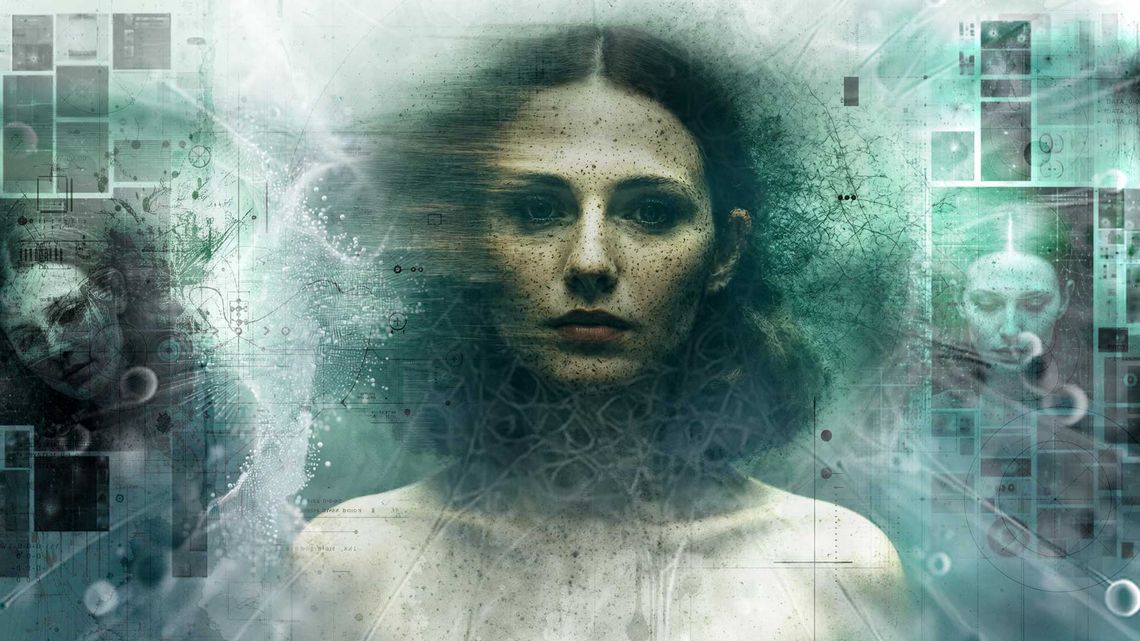
In the darkness, a point of light appears simultaneously across every surface. From it, lines emerge, converging to construct the reticulum. Within this reticulum live a vertical city under acid rain and three presences. A man who, for a year, has been trying to finish a single thing, each time burning away a piece of what remains to him; an artificial intelligence that decides to give itself a name and, at that very moment, decides to search for another; and Grace, the only voice that addresses those sitting in the darkness. Then the hum settles into a frequency that can be felt through the floor, and a crack of darkness simultaneously crosses the four walls and the floor. Something breaks, and the work declares the rupture while leaving it intact. Until that point, only the system’s generative sound is heard. Then a cello enters. First the system, then that which is human entering into it.
The work belongs to a form that the project defines as Immersive Reticular Cinema. The composition unfolds simultaneously across the room’s four walls and floor. The unit of narrative becomes the reticulum: the configuration formed by all the surfaces together at any given instant. Editing through succession is joined by editing through simultaneity, and each event occurs as something distributed across space.
The material emerges from generative systems that the authors train to operate according to a grammar they themselves define. What reaches the room is a fixed execution of those systems: five synchronised channels distributed across the walls and floor. For this reason, the work does not coincide with the film that unfolds before the viewer, but with the system that produces it. The file is merely one of the possible states that this grammar could have generated, fixed and made visible for these five minutes.
Residual Time is the temporal regime within which the entire body of work operates. A form continues to act beyond the instant of its appearance, through three thresholds: persistence, resonance, activation. What remains after a passage re-enters the system as living material and modifies its subsequent behaviour. This principle moves across multiple expressive forms, and Immersive Reticular Cinema is one of the languages through which it takes shape.
Inside the room, this becomes a concrete condition. With five active surfaces, each person sees only a portion, and those who enter halfway through the cycle encounter a different point from those who were already there. What the gaze has missed continues to operate as residue, and a second passage through the same loop reveals a different work.
There is a threshold in systems that generate creative outputs where noise has ceased to be noise, yet form has not fully arrived. It occurs at around thirty-three per cent completion and represents the moment of maximum density: the instant in which the process can be seen at work before the result conceals it. These five minutes stop there. The reticulum withdraws from the edges towards the centre, the point from which everything began returns, and the figure remains unchanged. The rendering stops at its own threshold and waits. In this first fragment, the wave function does not collapse.